
Beyond Symptoms
Body Reading for the Thinking Therapist
with Julian Baker BSc (Hons)
A practical two-day workshop for manual and movement therapists, who want to develop their observation, questioning and problem-solving skills.
This isn't about learning a technique or collecting anatomical knowledge, but about developing the confidence and perceptive skills to understand the person, rather than treating the symptoms they present with.
2027 Class Schedule
South Norfolk, 13&14 March
Needham Village Hall, Harleston, South Norfolk
9.00am - 5pm

About this class
What might we be regularly missing when we assess or talk to a client in front of us?
Why do some clients improve while others return with the same persistent problems, despite your best efforts?
Beyond the Symptoms is a practical two-day workshop for manual and movement therapists, who want to develop their observation, questioning and problem-solving skills.
Looking beyond familiar diagnostic labels, we'll discover why the most revealing questions aren't always the most obvious ones. You’ll learn how to recognise common movement strategies and separate dysfunction from adaptation and improve how you monitor change.
What if the problem isn't where we think it is?
People sometimes present with litanies of issues. Combinations like a painful shoulder, a stiff back,
recurring hip pain and hamstrings that always seem to be tight.
Where do you start?
Much of the language in therapy and movement looks at tissues or structures that are supposedly
tight, weak, misaligned or dysfunctional, and we then apply techniques or exercises to correct the perceived problem.
But what if those explanations are incomplete?
What if the movements we're trying to correct are actually really useful adaptations?
And what if where someone experiences pain has little to do with what's maintaining their problem?
Beyond the Symptoms is about developing the observation, reasoning and practical skills
to look beyond familiar explanations and start asking better questions.
Rather than simply identifying what's supposedly wrong with someone, we'll explore how their body has adapted, what their movement might be telling us, and how we can use that information to make better decisions.
This is not about learning another treatment technique or memorising more syndromes or anatomy.
Instead, it's about becoming a more curious, thoughtful and effective practitioner.
What you'll learn
Body reading reality - what can we reasonably infer from looking at someone?
Understanding movement strategies: guarding, avoidance, hesitation and more
Dysfunction or adaptation? Why not every unusual movement pattern is a problem.
Useful histories and questions: asking questions that change your thinking rather than simply filling in a form.
Meaningful measures that change outcomes: How to know whether what you're doing is actually helping.
Pain. Location vs Source: Why where somebody hurts doesn't necessarily tell you what is causing the problem.
The problem with syndromes, MRIs and X-rays
What's covered
Body Reading Reality
What does posture, movement and behaviour tell us and what do we need to consider differently?
We’ll explore the difference between observation and interpretation and learn to look deeper.
Less fixing. More understanding
Throughout the two days, we'll use practical observation, movement exploration, discussion and hands-on assessment to challenge familiar assumptions and develop new ways of approaching longstanding problems.
The problem with syndromes and MRIs:
While a diagnosis and things with labels are often reassuring and specific, they rarely offer a complete picture of a client.
We’ll look at some familiar diagnoses and popular syndromes, examine what might be missing
and learn to see the anatomy in an entirely different way.
Understanding movement strategies:
Guarding, avoidance, hesitation, altered loading, range and patterns can all provide useful insight about how someone negotiates their environment.
Dysfunction or adaptation?
Not every unusual movement pattern is a problem.
Sometimes the body has developed a perfectly successful solution to the demands placed upon it.
We’ll learn to distinguish between protective strategies over things that might benefit from attention or treatment.
Practical and Hands On
There will be lots opportunities to work with other participants, investigate different movement strategies and practice applying the ideas directly.
You'll be encouraged to question what you see, explain your reasoning and occasionally discover that something you were certain about, might not be quite so certain after all.
The aim isn't to leave with a collection of new techniques. It's to leave with a better understanding of when, why and how to use the skills you already have.
Who this class is for?
This workshop is designed for anyone whose work involves observing, assessing or helping people move.
Whether you're a massage or manual therapist, Bowen practitioner, osteopath, physiotherapist, yoga or Pilates teacher, movement educator or personal trainer, you'll find ideas and practical approaches you can apply to your own work.
You don't need to subscribe to a particular treatment model or philosophy. In fact, a willingness to question the one you already use is probably an advantage.
Meet your tutor
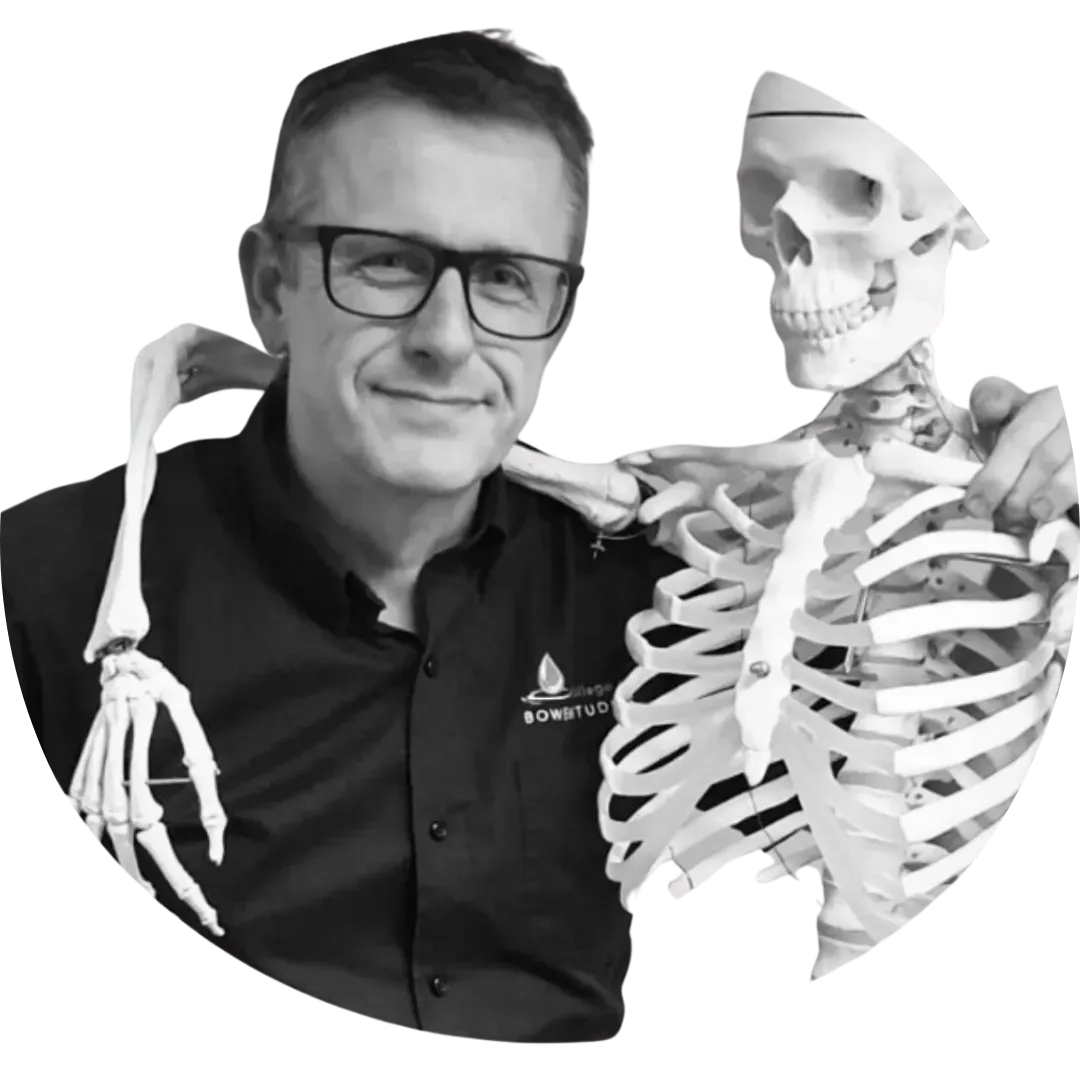
Julian Baker BSc (Hons)
Functional Anatomist and Health Science Educator
Julian Baker has been teaching anatomy, dissection and bodywork classes for over thirty years. Something of a heretic within the anatomical establishment, he challenges the norms of conventional anatomical thinking and creates a new paradigm in how anatomy is taught.
He brings an unusual combination of practical experience, anatomical knowledge and a healthy scepticism towards some of the explanations commonly offered in the world of bodywork.
With decades worth of experience in the therapy field and a depth of knowledge that is second to none, any learning experience with him is unforgettable.