
Nerves and What They Do

You’ve Got a Nerve: What Nerves Actually Do
Well, actually you’ve got billions of nerves, operating constantly on an enormous number of levels. But what are they actually doing?
The nervous system is often described like an electrical system, with nerves as the cables. That image then gets carried into the way we talk when things go wrong. A nerve gets “trapped” or “pinched”, a disc “presses on a nerve”, someone has a “damaged nerve”, and pain travelling down the leg gets labelled sciatica.
While there’s some degree of truth in those descriptions, nerves are more interesting than simple wires carrying impulses around the body.
Any named nerve, axillary, vagus, sciatic, isn’t a single wire, but is a bundle containing huge numbers of individual nerve fibres, or axons, organised into smaller bundles called fascicles and wrapped in connective tissue. The basic nerve structure consists of;
axon
fascicle
whole nerve
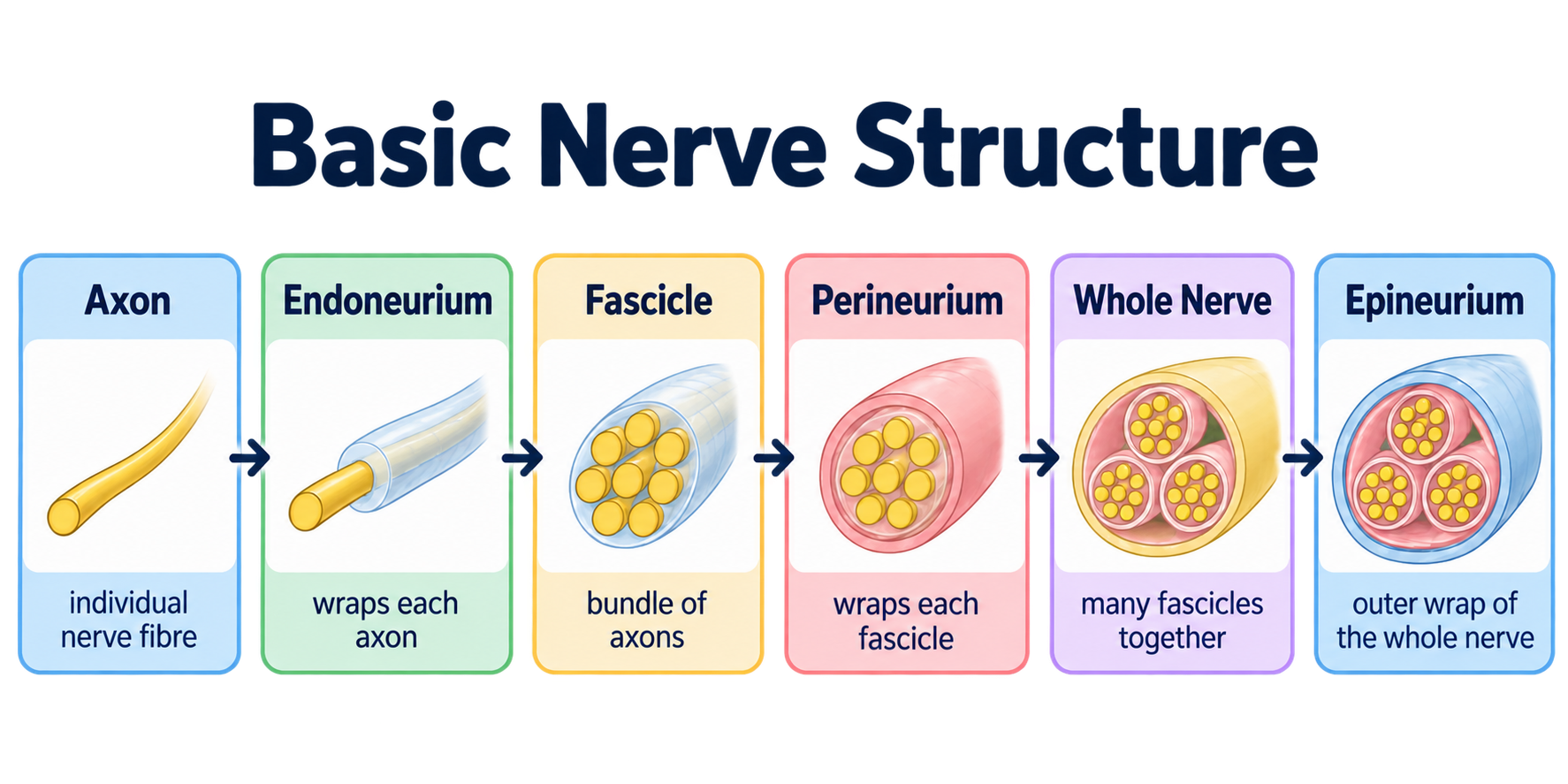
While you don’t need to remember any of this (follow the links to rabbit hole), the point is that a peripheral nerve is not just naked wiring. It has structure, support tissue, blood vessels and many fibres carrying different sorts of information.
The sciatic nerve is formed from fibres coming from spinal nerve roots, mainly L4 to S3. These combine in the pelvis, travel through the gluteal region and down the thigh, before continuing mainly as the tibial and common fibular nerves, (peroneal nerve in old money).
Pain down the outside of the calf or into the foot is therefore already more complicated than one simple structure called the sciatic nerve.
What do nerves actually DO?
It may sound like a stupid question, but stupid questions have always been my area of expertise, so read on!
A named nerve such as the sciatic nerve, contains both afferent and efferent fibres, information travelling towards the central nervous system and information travelling away from it. But importably each individual neuron and its axon can carry a nerve signal in only one direction.
Sensory afferent neurons carry information towards the central nervous system from things such as touch, temperature, tissue change, joint position and potential threat. In turn, motor efferent neurons carry signals away from the central nervous system towards muscles, skin and other tissues.
There is another pretty awesome bit of engineering going on inside the axon that organises the need for information to run two ways. This is the system of microtubules, which act like a kind internal postal system railway. Information can be moved in both directions along these tracks,towards the end of the axon and back towards the cell body, even though the nerve signal itself is travelling in its one functional direction. So a named nerve will contain traffic going both ways, while each individual nerve fibre has its own direction of signalling.
Importantly however, the nerves themselves don’t interpret or assign meaning to any of the signals they carry and are just messengers.
Pain is a good example. Nociception, the nervous system’s process of detecting actual or potential threat, can contribute to pain.However pain itself is not a substance or even a specific signal sent from damaged tissue to the brain, but is an experience produced by the nervous system.
This is why radiating pain doesn’t necessarily mean the sciatic nerve or anything else has been actually damaged.
We can experience pain without damage and damage without pain.
Nerves are electrical. Sort of.
Although I’m trying to dismantle the electrical/cable imagery, there is an electrical aspect to nerve signalling, that could more accurately (or pedantically) described as electrochemical.
Like batteries, nerve cells maintain a difference in electrical charge between the inside and outside of their membrane. When triggered by touch, sound or anything other trigger, tiny channels open and electrically charged particles move across the membrane.
This produces what is known as an action potential, a frequency which travels along an individual nerve fibre, or axon.
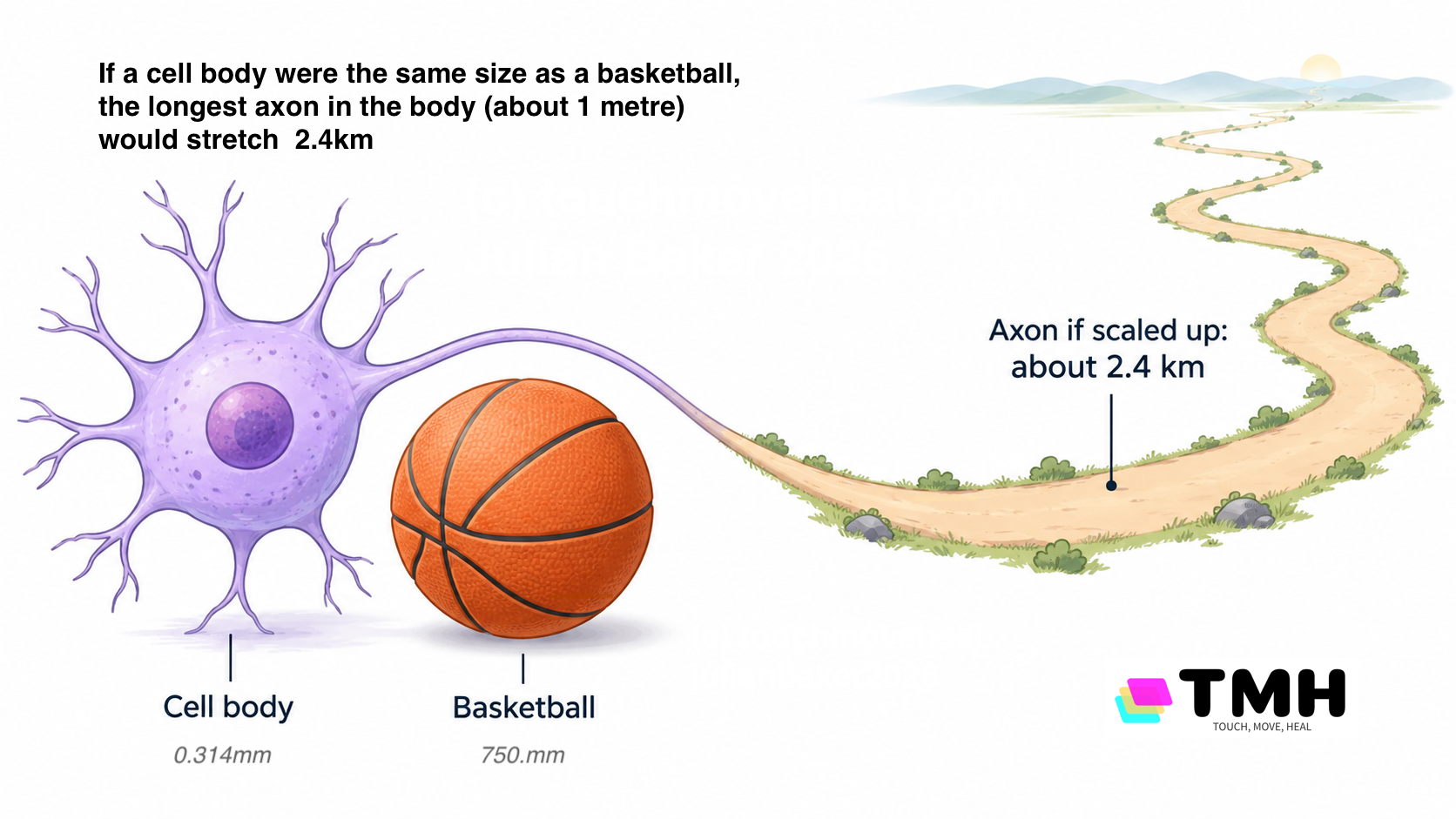
Some axons are wrapped in a fatty sheath called myelin, which speeds transmission along what can be incredibly long distances. For comparison, if the cell body of one of our longest motor neurons were enlarged to the size of a basketball, its axon would stretch for roughly 2.4 kilometres.
The signal leapfrogs across gaps in the myelin called nodes of Ranvier in a process called saltatory conduction saltare being Italian for jump or leap.
One more geeky distinction (and if you've read this far, I'm guessing you'll appreciate it), in the brain and spinal cord myelin is produced by oligodendrocytes; in peripheral nerves, including the sciatic nerve, by Schwann cells.
The names matter less than the idea that a nerve is living tissue, not inert wire.
Why does your hand go numb when you lie on it?
Most people have woken with an arm or hand that appears to belong to somebody else. It feelsnumb, doesn’t move properly and then as sensation returns,pins and needles (paraesthesia) flood in
(If you’re recalling a Billy Connolly joke at this point, you’re showing your age.)
So what’s going on and has the nerve been damaged? Almost certainly not.
Pressure for long enough has just temporarily interfered with local circulation and nerve conduction. We change position and function returns, often with the tingling or paraesthesia along the way.
This serves a really useful point, which is that a nerve behaving oddly is not necessarily damaged. Prolonged or severe pressure can indeed cause genuine injury, but every episode of tingling doesn’t mean damage.
Nerves have to move
Nerves are not fixed in one position, but move and slide relative to surrounding tissues as joints and muscles change position. Movement through the hip, knee or ankle will change the environment inhabited by the sciatic nerve and its branches, but it doesn’t mean we are “stretching the nerve” like an elastic band or that we should try!
So-called nerve stretches can therefore be better thought of as neurodynamic tests. They alter the environment of neural tissue and may change symptoms, but still don’t tell us exactly why somebody hurts.
What if a nerve really is injured?
Peripheral nerves can of course be injured by trauma, disease or sustained pressure and all of these can, produce, to name but a few, altered sensation, weakness, reflex changes, neuropathic pain or loss of function.
Damaged nerves can regenerate to some extent, helped partly by Schwann cells, but the process is slow and complicated and severe nerve damage is a very different thing from pins and needles after sleeping on your arm.
Spinal nerve roots are however quite different and the distinction is critical when we talk about something like sciatica. The fibres that will eventually contribute to the sciatic nerve, begin much closer to the spinal cord and have less of the protective connective-tissue wrapping seen in mature peripheral nerves, which may make them more vulnerable to irritation.
Someone therefore may have symptoms arising from an irritated lumbar nerve root without having “damaged the sciatic nerve” in the buttock or thigh, an easily blurred distinction.
Does a disc have to squash a nerve?
No. As we’ve discussed, compression can play a role, but is rarely the whole story. Disc material can be associated with inflammation, and nerve roots can also become chemically irritated or sensitised.But the simple model of disc pressing on nerve equals pain, is too tidy.
Compression, inflammation and altered neural sensitivity may all be involved, sometimes at the same time and this fits with imaging techniques such as MRIs.
Significant disc changes can be seen from images with someone experiencing no pain, while others can have severe radiating pain without dramatic visible compression.Normal is often hard to find!
So what exactly is sciatica?
“Exactly” is doing a lot of work here and it may be more useful to think of ‘sciatica’ as a description rather than a diagnosis: some variation of pain travelling from the back or buttock into the leg.
Sometimes there is clear nerve-root involvement, weakness or sensory change, sometimes there isn’t and sometimes the pattern doesn’t map particularly neatly onto the sciatic nerve at all.
I should say at this point that there are some flags associate with sciatic type pain that should be investigated and my Flags for Therapist course is something that every therapist should take to safeguard themselves and their clients.
But if pain runs down the outside of the leg, what else might we consider? If it sits around the hamstring region, is the sciatic nerve definitely the source? Could poorly controlled gluteal function contribute to pain labelled sciatica even when the nerve is not the main issue?
And once symptoms enter the lower leg, remember that the huge sciatic nerve has already divided into other peripheral nerves often with their own names.
Perhaps we therefore might need better questions rather than simply looking for something to “release” or a nerve to “untrap”.
New language alert
Much of my mission is to encourage a different way of talking about what we do and looking for better descriptions and explanations of the work thatmanual and movement therapists do.
That in mind, whilst the electrical-wiring analogy has served us reasonably well, but it also limits thinking when it comes to nervous tissue. Nerves are living tissues that move, adapt and respond to changing physiological environments. They have a blood supply and supporting cells and can become irritated without being damaged and all of this makes them so much more interesting and diverse than mere conduits of energy.
And finally, symptoms are notoriously poor road signs to an exact cause, and they often appear at the end of a process that started a long way away and a long time ago.
So when someone says, “My sciatic’s playing up,” they may be right, but it’s definitely worth asking a few more questions before really believing it.
Links for further reading
Giuffre BA, Black AC, Jeanmonod R. Anatomy, Sciatic Nerve. StatPearls.
A straightforward anatomical overview of the sciatic nerve, its roots, course and branches.
Taveggia C. Schwann cells–axon interaction in myelination. Current Opinion in Neurobiology. 2016;39:24–29.
A useful deeper dive into the relationship between peripheral axons, Schwann cells and myelin.
Simons M, Nave K-A. Oligodendrocytes: Myelination and Axonal Support. Cold Spring Harbor Perspectives in Biology. 2016.
For anyone wanting to explore myelin and the role of oligodendrocytes in the central nervous system.
Berry JA et al. A Review of Lumbar Radiculopathy, Diagnosis, and Treatment. Cureus. 2019.
A broad clinical review of lumbar nerve-root symptoms, examination and diagnosis.
Dydyk AM et al. Lumbar Radicular Pain.
A useful overview of nerve-root anatomy and the combination of mechanical and biochemical factors that can contribute to radicular symptoms.


