
Hip Stability - More Than Just Local Weakness
Hip Stability: Local Weakness or a System Problem?
Hip Stability Webinar Click Here
Anyone working in movement, therapy or sports massage will recognise how often the phrase “hip stability” appears.
A client presents with balance issues, a knee drifting inwards, recurrent back pain, a pelvis that drops during walking, or a hip that feels unreliable, and the explanation quickly narrows to one place: the hip is “unstable.”
From there, the solution is predictable.The advice is strengthen the glutes, “turn them on,” add a resistance band, prescribe clamshells and monster walks. If things improve, the story is confirmed. If they don’t, the assumption is that something else needs activating.
Cynical as I might sometimes sound, (who me?) there is enough truth in this to make it believable, which is usually where the many problems start. Hip abductors are important and it’s been shown that people with hip osteoarthritis do have less strength when trying to abduct the hip. (Marshall et al., 2016). Exercise therapy also improves pain and function in these populations (Teirlinck et al., 2023). The issue isn’t strengthening itself, but the assumption that hip stability is simply a local strength issue waiting to be corrected.
So what do we mean by “stable”?
Anatomically, isn’t exactly hanging on by a thread. It is a deep ball-and-socket joint designed for load transfer, supported by a strong capsule, labrum, ligaments and surrounding muscles. The acetabular labrum and iliofemoral ligament contribute act like seat belts for the hip, resisting forward movement and the hip being pulled out of place. (Myers et al., 2011). The capsule itself maintains stability and keeps everything in place, especially in small amounts of instability and also in any post-surgical recovery (Bolia et al., 2016).
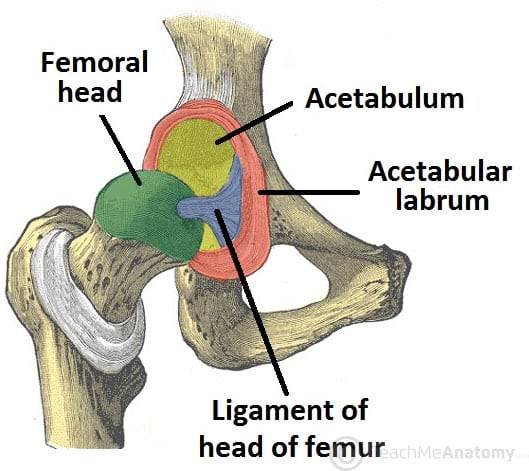
When people say “unstable hip,” they are rarely suggesting imminent dislocation. True structural instability is specific and relatively rare. More often, the term reflects a behaviour we’ve all witnessed: some loss of control or confidence standing on one leg, maybe some guarded or awkward movements.
These are all a long way from the joint being mechanically “loose.” The language of stability can also often implies stillness, as if a stable hip should hold the pelvis level like a table leg. The difference is that living systems don’t stabilise themselves by becoming rigid, but do it through constant adjustment.
Walking across a room is not about maintaining fixed alignment. The very act of walking is the body is recovering from a controlled, rotating fall after each step and using the foot, knee, hip, pelvis, spine, trunk, head, eyes as well as the nervous system to do it. This is why someone could appear strong in a controlled setting yet disorganised when climbing stairs or turning quickly.
Tests and tasks are not the same thing!
Hip stability is therefore better understood as a behaviour of the whole system rather than a property of a single joint. The feet provide information about the ground, the knees manage load and rotation, the pelvis transfers weight, and the spine stabilises what sits above. Meanwhile the nervous system is trying to predicts what is safe or not and what level of muscular activity is required, whilst remembering to take the washing out of the machine and buy tonic, even before any movement has even happened. (Hodges and Tucker, 2011).
Glute Med? Maybe
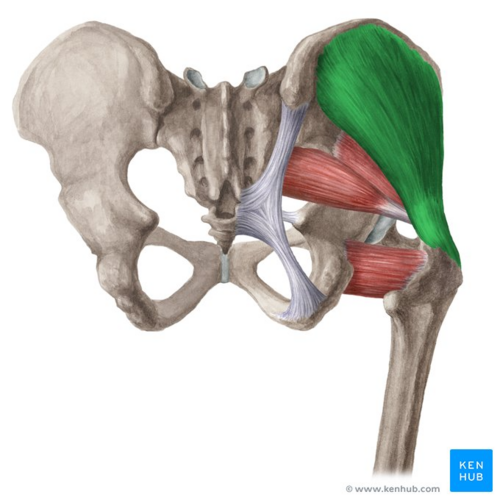
The focus on gluteus medius is both useful and incomplete. Hip abductors do of course contribute to pelvic control and ignoring them would be daft. But weakness alone doesn’t define instability and increased strength does not guarantee better movement. Strength might gives any system the capacity to do or withstand more, but this doesn’t automatically confer confidence or trust.
This is something often seen in people with hip osteoarthritis who may have any combination of pain, stiffness, reduced range, altered gait, weakness and so forth, resulting in a tendency to avoid loading the affected side. Some will be structural and local to the hip, whilst some of it will be be behavioural and protective. How much is the key question!
Similar patterns are seen after total hip replacement, sometimes persisting for years (Labanca et al., 2021). This isn’t ongoing joint instability, just a sign thatreplacing the joint surface doesn’t automatically restore full sensory and movement relationships across the board.
People often feel unstable long before any structural issue exists. They may avoid loading one side, brace during movement, shorten their stride or shift weight asymmetrically. Coping strategies that will have often started gradually and long before pain became a serious issue.
From the outside, these patterns may be labelled as weakness or poor control, but for the individual, they are reasonable protective strategies. Treating them purely as strength deficits risks missing the underlying issue.
If someone cannot produce enough force to perform a task, then strengthening is sensible. But if the problem is threat, a lack of sensory confidence, foot instability, fear of pain (or the sheer fatigue of that fear) then simply having ‘stronger’ muscles isn’t going to help and could mask the true identity or culprit.
There is also the concept of secondary instability, where apparent problems in one region are influenced by another. Movement is never isolated. Reaching overhead involves not just the shoulder, but the hip, pelvis, spine and feet creating the conditions for that reach.
Just as a restricted shoulder may not simply be a shoulder problem, a restricted hip may not only belong to the hip. The same nervous system that controls and protects the hip is also controlling and protecting the shoulder, neck, trunk and head, and it will use whatever strategy is available to prevent a movement it does not currently trust or feel safe with.
This becomes obvious in simple tasks like standing up from a chair where. strong hips alone aren’t going to be enough if the head and trunk don’t shift forwards. The feet in turn have to receive the load, and only then can the hips and legs push us into standing.
This is why skilled body reading is so helpful, because what looks like local weakness or local restriction may actually be a problem elsewhere in the system. Again, none of this means abandoning strengthening but simply changing what we think strengthening is actually for.
Targeted exercises can be incredibly helpful to explore movement in areas that feel vulnerable. But at some point the work has to leave the session room, become functional and able to transfer into meaningful tasks. A clamshell may strengthen an abductor, but it doesn’t teach someone how to catch themselves when they trip.(Lee and Kim, 2018)
So maybe the better question is less about whether the hip is stable and more about when it stops being reliable. The phrase hip stability isn’t wrong, but it is often too blunt and can hide the difference between a structurally unstable joint and a person who has learned not to trust one side of themselves.
Reducing an issue to “weak glutes”, might also help some people. Strength after all is rarely a bad place to visit. But it is a poor place to live if the actual issue is a system that has lost confidence or trust in their ability to load and adapt.
References
Bolia, I.K., Chahla, J., Locks, R., Briggs, K.K. and Philippon, M.J. (2016) ‘Microinstability of the hip: a previously unrecognized pathology’, Muscles, Ligaments and Tendons Journal, 6(3), pp. 354–360.
Hodges, P.W. and Tucker, K. (2011) ‘Moving differently in pain: a new theory to explain the adaptation to pain’, Pain, 152(3 Suppl), pp. S90–S98.
Labanca, L., Rocchi, J.E., Benedetti, M.G., Avanzolini, G. and Della Croce, U. (2021) ‘Balance and proprioception impairment, assessment tools, and rehabilitation training in patients with total hip arthroplasty: a systematic review’, BMC Musculoskeletal Disorders, 22, article 1055.
Lee, J.and Kim, T.H. (2021) ‘Effects of Hip Joint Strengthening Exercises and Lumbopelvic Stabilization Exercises on Balance and Instability of Adults with Functional Ankle Instability’, International Journal of Human Movement and Sports Sciences, 9(4), pp. 757–764.
Marshall, A.R., Noronha, M., Zacharias, A., Kapakoulakis, T. and Green, R. (2016) ‘Structure and function of the abductors in patients with hip osteoarthritis: systematic review and meta-analysis’, Journal of Back and Musculoskeletal Rehabilitation, 29(2), pp. 191–204.
Myers, C.A., Register, B.C., Lertwanich, P., Ejnisman, L., Pennington, W.W., Giphart, J.E., LaPrade, R.F. and Philippon, M.J. (2011) ‘Role of the acetabular labrum and the iliofemoral ligament in hip stability: an in vitro biplane fluoroscopy study’, The American Journal of Sports Medicine, 39(Suppl), pp. 85S–91S.
Teirlinck, C.H., Verhagen, A.P., Reijneveld-van de Vendel, E.A.E., Swart, N.M., van Ravesteyn, L.M., Koes, B.W. and Bierma-Zeinstra, S.M.A. (2023) ‘Effect of exercise therapy in patients with hip osteoarthritis: a systematic review and cumulative meta-analysis’, Osteoarthritis and Cartilage Open, 5(1), article 100338.


