
THE MONDAY WEBINAR SERIES:
Hip Stability - What is it and where does it come from?
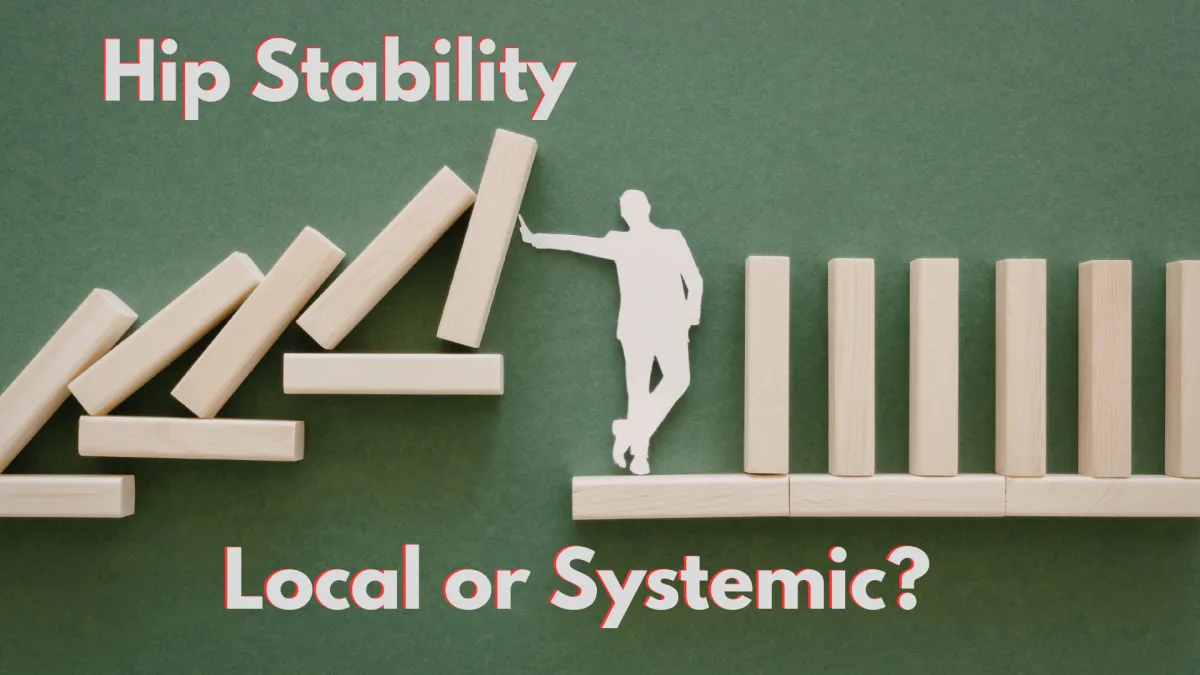
Why doesn't hip stability improve despite strengthening exercises? Is the problem local, systemic, or are we missing something else and what does 'hip stability' really even mean?
Why do some people have poor hip stability? Is it simply a weak glute, poor motor control, a local tissue problem, or is something else going on?
Do people needing hip replacements have unstable hips for instance? The answer may surprise you!
The assumption is often made, that if we strengthen the muscles around the hip, stability will improve.
If someone has hip pain, movement dysfunction, balance issues, or recurrent injury, after treatment and exercises, we expect better stability. But what happens if that doesn't happen?
In this webinar, we'll explore what we mean by hip stability and whether it's really a local issue or part of a larger system.
We'll examine how the hip interacts with the foot, trunk, pelvis, nervous system and wider movement behaviour, and why lasting improvements often require us to look beyond the hip itself.
We’ll explore:
Why strengthening the hip alone often fails to create lasting stability
The difference between muscle strength and movement stability
Is hip stability a local problem, a systemic problem, or both?
How the entire kinetic chain contributes to hip function
Why the source of instability may not be where symptoms appear
How the nervous system influences stability and movement control
What happens when local and systemic factors interact
How to identify the key drivers of hip instability
Practical ways to assess and treat hip stability more effectively
Why working the hips doesn't always improve stability
For permanent access to this and previous webinars
Join the Archive Membership
£12.50
per month
ABOUT THIS WEBINAR
Hip Stability-Local or Systemic?
This webinar is for therapists, movement teachers and trainers who want to better understand hip stability from both local and systemic perspectives.
In this webinar we'll explore:
The common and often misleading belief that hip stability is simply a strength problem
The difference between a stable and an unstable hip
Why hip stability is often about more than the muscles surrounding the hip
The difference between local stability and whole-system movement control
Why strong hips don't always create stable movement
How the foot, pelvis, trunk and nervous system contribute to hip stability
Why recurring hip problems often persist despite targeted strengthening programmes
How compensatory movement strategies can influence hip function
Why the source of instability may not be where symptoms are felt
What current evidence can teach us about local versus systemic approaches to hip stability
How small changes in assessment and treatment can dramatically improve outcomes
Format & access
Recorded webinar (approx. 60 minutes)
Available Instantly
Ongoing access available via the
Webinar Collection Membership
Other Webinars in the Series
Core and core stability
The myth of muscle growth and micro-trauma
Stretching- what's really happening?
Why clients won't do their homework
Hip stability - more than just a local issue
Adhesions vs scars. What's the difference?
Fascia in the ageing body
Shoulders aren't ball and socket joints
Spines negotiate rather than collapse
Fascia and Load
Pain. Systems not structures
Forward head posture. The new smoking?
Knee Pain. New thinking, better outcomes
Frequently Asked Questions FAQs
What is this hip stability webinar about?
This recorded webinar explores hip stability, hip pain, weak glutes, strengthening exercises, movement control and whether hip instability is a local hip problem or part of a wider system.
Why does hip strengthening not always improve stability?
Hip strengthening may improve muscle capacity, but stable movement also depends on the pelvis, foot, trunk, nervous system, balance, timing, load and wider movement behaviour.
Are weak glutes always the cause of poor hip stability?
Weak glutes can be relevant, but they are not the whole story. Poor hip stability may involve coordination, load strategy, foot mechanics, pelvic control, trunk behaviour, pain sensitivity and confidence in movement.
Is hip stability a local or systemic problem?
Hip stability can involve local tissues around the hip, but it often depends on how the whole system organises movement. The webinar explores both local and systemic contributors.
Who is this hip stability webinar for?
This recorded webinar is for therapists, movement teachers, trainers, bodyworkers and health practitioners who want a clearer way to think about hip stability, hip pain, strengthening and movement control.
ABOUT JULIAN
JULIAN BAKER BSc (Hons)
Functional Anatomist and Health Science Educator
Julian has been teaching anatomy, dissection and bodywork classes for over thirty years.
Something of a heretic within the anatomical establishment, he challenges the norms of conventional anatomical thinking and creates a new paradigm in how anatomy is taught.
His humorous, gentle and patient approach encourages application over academic knowledge and seeks to dismantle what many of us take for granted.
Julian has decades worth of experience in the therapy field and has a depth of knowledge that is second to none, ensuring that any learning experience with him is unforgettable
READ SOME REVIEWS
Don't just take our word for it...
"To 'see' the soft tissue we as therapists think we influence is a privilege. Julian Baker makes all the right connections between the 'tissue' and considerations for therapeutic intervention. Functional Anatomy is a must for all 'hands on' therapists. It is also a must for the 'hands off' body of therapists! Seeing is believing.."
"Captivating, often bizarre and incredible insights into the human body like you have never seen before. Always life changing sessions, questioning the “norm” as we are taught it and bringing new dimensions to your practise.
If you attend one of Julian's classes your working brain will be changed forever - for the better and you will only want to see more!! His humour is also legendary!!"
"I have just participated in the scar tissue dissection course. This is an incredible lesson in anatomy. Julian takes you on a journey thru a human body like you've never been before. It is amazing to see how a human body is really built, how strong, how resilient. Eye-opening and educating. Thank you.
I will be back for more."
ARE YOU READY TO BUY THIS WEBINAR?
We're excited to have you on board!
Site: www.touchmoveheal.com
Email: [email protected]

Touch Move Heal All rights reserved