
THE MONDAY WEBINAR SERIES:
Deep Tissue Techniques:
Does More Pressure Mean More Change?
LIVE: Monday 3rd August 7pm
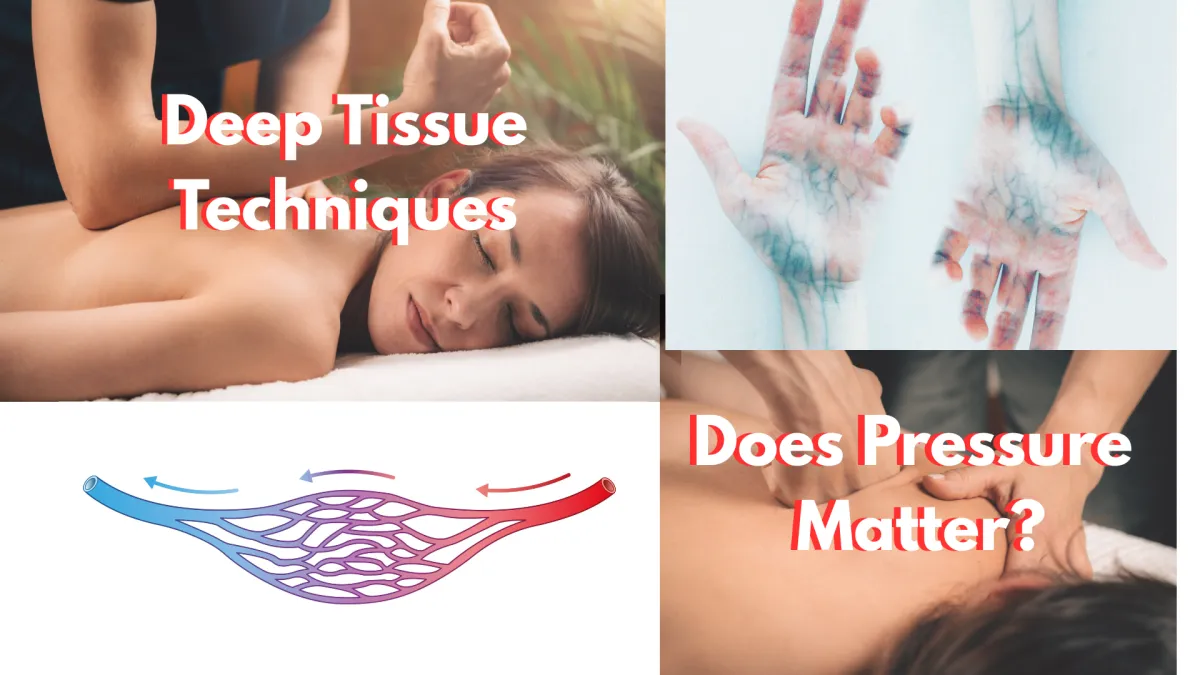
Deep tissue massage, Rolfing, structural integration, KMI, myofascial release and other hands-on approaches may use different language, but many share a similar assumption: that deeper pressure creates deeper structural change.
Therapists talk about 'releasing' fascia, breaking down adhesions, loosening deep muscles and accessing tissues that lighter touch supposedly cannot reach.
But what does “deep” actually mean?
How much force actually reaches the tissues we think we are treating? Can pressure mechanically release fascia or break down adhesions? And if people genuinely feel and move differently afterwards, what else might explain the change?
In this webinar we’ll explore what pressure actually does, from fascial release or tissue deformation and fluid movement to mechanoreception, sensation, pain modulation and nervous-system response — and ask whether more pressure really means more effect.
We’ll explore:
What “deep tissue” actually means anatomically — and what our hands can realistically reach.
Whether pressure can mechanically “release” fascia, break down adhesions or permanently lengthen tissue
Why feeling tissue soften beneath the hands does not necessarily mean its structure has changed.
How different levels of pressure stimulate mechanoreceptors and sensory pathways.
Sensory receptors — and why “deeper” does not simply mean “more neurological input”.
Why some people love deep pressure while others guard against it.
How treatment can produce, change even when the traditional explanation for that change might be wrong.
How to choose pressure according to the person in front of you rather than the ideology of a particular technique.
Does Pressure and Depth Really Matter?
You could be working harder than you need to.
For permanent access to this and previous webinars
Join the Archive Membership
£12.50
per month
If we aren't “releasing” tissue, what are we doing?
Skin, connective tissue, muscles and joints contain sensory receptors responsive to touch, pressure, stretch, vibration and movement.
Different forms of manual contact create different patterns of sensory information that are interpreted by the nervous system.
Mechanoreceptors including Ruffini endings and Pacinian corpuscles, alongside many other sensory nerve endings, contribute to this information.
But they should not simply become a replacement myth — “we used to release fascia, now we stimulate Ruffini endings”.
The response to touch emerges from the whole interaction: pressure, movement, expectation, context, previous experience, perceived safety and the meaning the person gives to treatment.
ABOUT THIS WEBINAR
Deep Tissue or Not: Does Pressure Really Matter?
This webinar is for therapists, trainers, and movement professionals who want to understand how deep and light pressure affect the body from both local and whole-body perspectives.
In this webinar we'll explore:
The common but misleading belief that deeper pressure always creates better results.
The difference between local pressure effects and whole-body responses.
How the body, nervous system, and movement patterns influence the effects of deep and light pressure.
Why the source of discomfort may not be where the pressure is applied.
How small changes in pressure choice and treatment approach can significantly improve outcomes.
Format & access
Recorded webinar (approx. 60 minutes)
Available Instantly
Ongoing access available via the
Webinar Collection Membership
Other Webinars in the Series
Understanding GLP-1 Weight Loss Jabs
Core and core stability
The myth of muscle growth and micro-trauma
Stretching- what's really happening?
Why clients won't do their homework
Hip stability - more than just a local issue
Adhesions vs scars. What's the difference?
Fascia in the ageing body
Shoulders aren't ball and socket joints
Spines negotiate rather than collapse
Fascia and Load
Pain. Systems not structures
Forward head posture. The new smoking?
Knee Pain. New thinking, better outcomes
Frequently Asked Questions FAQs
Is deeper pressure more effective than light pressure?
Not necessarily. More pressure creates a different sensory and mechanical input, but greater force does not automatically produce a better clinical outcome. The most useful pressure depends on the individual, context and aim of treatment.
What do mechanoreceptors do during a manual therapy session?
Mechanoreceptors and other sensory nerve endings respond to touch, pressure, stretch, vibration and movement. This sensory information contributes to how the nervous system responds to treatment, but no single receptor explains the effects of manual therapy.
Does deep tissue massage, Rolfing or structural integration really 'release' fascia?
People may feel and move differently after deep tissue massage, Rolfing or structural integration, but this does not prove that fascia has been mechanically “released”. Changes may involve sensation, pain modulation, muscle activity, movement, expectation, context and nervous-system response, alongside temporary tissue deformation.
Does deeper pressure reach deeper tissue?
More pressure can deform tissue and transmit force further into the body, but biological response is not simply proportional to depth. Sensory input, tissue state, expectation, context, guarding and nervous-system response all influence the outcome.
Can massage break down adhesions or scar tissue?
The idea that external pressure simply breaks down mature scar tissue or deep internal adhesions is an oversimplification. Tissue remodels over time, but feeling something change beneath the hands does not demonstrate that an adhesion has been mechanically broken apart.
Why can tissue feel softer after deep tissue massage?
A change in tissue feel may reflect altered muscle activity, fluid movement, temporary deformation, sensory perception and changes in guarding. Feeling softer is an observation; saying “I released the fascia” is an interpretation not a demonstrated outcome or mechanism.
Can light touch produce meaningful effects?
Yes. Light touch provides substantial sensory information without high mechanical force. Different people respond differently, and more force does not automatically mean more meaningful input.
Who is this webinar for?
This webinar is for massage therapists, manual therapists, bodyworkers and movement professionals who want to understand what pressure and touch may actually be doing without relying on simplistic “release” explanations.
ABOUT JULIAN
JULIAN BAKER BSc (Hons)
Functional Anatomist and Health Science Educator
Julian has been teaching anatomy, dissection and bodywork classes for over thirty years.
Something of a heretic within the anatomical establishment, he challenges the norms of conventional anatomical thinking and creates a new paradigm in how anatomy is taught.
His humorous, gentle and patient approach encourages application over academic knowledge and seeks to dismantle what many of us take for granted.
Julian has decades worth of experience in the therapy field and has a depth of knowledge that is second to none, ensuring that any learning experience with him is unforgettable
READ SOME REVIEWS
Don't just take our word for it...
"To 'see' the soft tissue we as therapists think we influence is a privilege. Julian Baker makes all the right connections between the 'tissue' and considerations for therapeutic intervention. Functional Anatomy is a must for all 'hands on' therapists. It is also a must for the 'hands off' body of therapists! Seeing is believing.."
"Captivating, often bizarre and incredible insights into the human body like you have never seen before. Always life changing sessions, questioning the “norm” as we are taught it and bringing new dimensions to your practise.
If you attend one of Julian's classes your working brain will be changed forever - for the better and you will only want to see more!! His humour is also legendary!!"
"I have just participated in the scar tissue dissection course. This is an incredible lesson in anatomy. Julian takes you on a journey thru a human body like you've never been before. It is amazing to see how a human body is really built, how strong, how resilient. Eye-opening and educating. Thank you.
I will be back for more."
Want to rethink what your hands are actually doing?
We're excited to have you on board!
Site: www.touchmoveheal.com
Email: [email protected]

Touch Move Heal All rights reserved